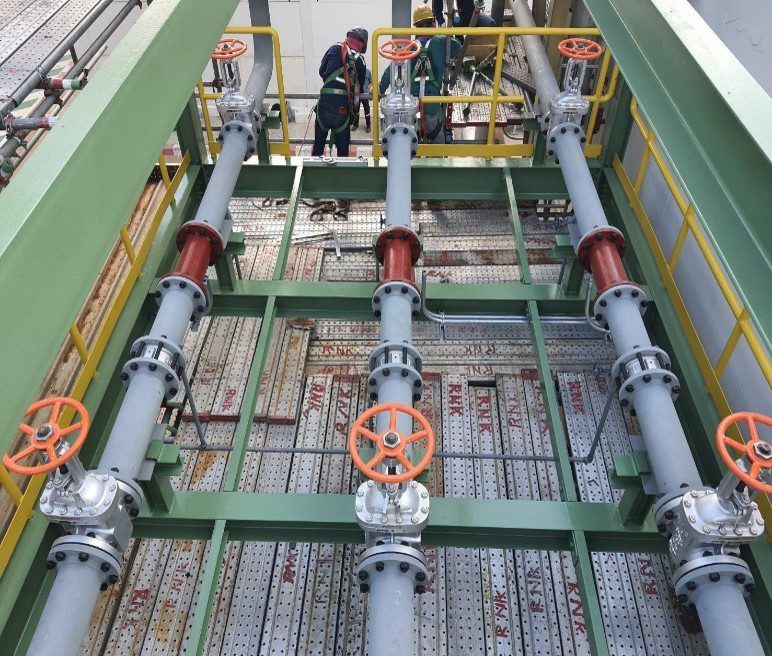
Isolation = stop/allow + tight shutoff. Control = modulate. Don't swap their jobs.
Size on Cv at max flow; check normal ~60–80% travel, min > ~10%.
| Characteristic | Use when |
|---|---|
| Equal-% | Most flow/pressure control. |
| Linear | Level & constant-ΔP. |
| Quick-opening | On/off-ish, fast relief. |
Holds a setpoint (flow/pressure/level/temp) → control valve (globe is the default; rotary for big bore / high Cv). Size on Cv so normal flow is ~60–80% travel. Equal-% for most flow/pressure control; linear for level. Add 2 isolation valves + (often) a bypass around it. Pick fail action from the safe state.
choose from the safe state on loss of air/signal: fail-closed (FC) stops flow (e.g., fuel), fail-open (FO) keeps cooling/relief flowing, fail-last (FL) holds position. This is a process-safety decision, set on the cause-and-effect chart.
Fail action — FC stops flow, FO keeps cooling/relief, FL holds — a safety decision.
| Symptom | Cause & fix |
|---|---|
| Hunting near shut | Oversized → resize. |
| Noise / trim erosion | Cavitation → anti-cav trim. |
| Sticky response | Actuator/positioner → check & size. |
Standards — IEC 60534 / ISA 75; FCI 70-2; ASME B16.34.